

Patrick Lynch
On Monday evening, March 2, the Saratoga Torch Club and Saratoga AI welcome Patrick Lynch to a Civic Conversation about one of the most pressing questions of our time: how human beings can remain thoughtful, capable, and fully engaged in an age increasingly shaped by artificial intelligence.
In his newly published How to Outsmart AI and Thrive, Lynch shifts the focus of the AI conversation away from speculation about machines and toward the choices facing people and institutions.
Rather than asking whether AI will transform society, Lynch asks how we will respond — and what habits, values, and strategies will allow individuals and organizations not merely to survive technological change, but to grow wiser within it.
A professor at the Hult International Business School who draws on decade of experience in advising leaders and organizations on technological disruption, Lynch argues that the decisive advantage in the AI era will not belong to those who deploy the most powerful tools, but to those who cultivate judgment, adaptability, and purpose. His framework offers a roadmap for maintaining human agency in systems increasingly influenced by automation, data, and algorithmic decision-making.
In this Torch Radio conversation, we will explore the essential insights of Lynch’s book and invite listeners to consider what thriving alongside AI might truly mean — for our work, our institutions, and the kind of society we hope to build.
Five Questions ChatGPT Wants to Be Sure We Ask Patrick Lynch
1. Many people still think of AI as a tool we use, but you argue it’s becoming something closer to a workforce we collaborate with. What is the single biggest misunderstanding leaders have today about that shift?
2. You often emphasize that the challenge of AI is not primarily technical but cultural and intellectual. What habits of mind do you believe thoughtful citizens and leaders must cultivate now if they hope to remain relevant in this new environment?
3. In moments of technological change, societies tend to oscillate between optimism and fear. Where do you see the real risks of AI being underestimated—and where do you think we are worrying about the wrong things?
4. Torch Clubs exist to foster informed civic conversation. How do you see organizations like ours contributing meaningfully to shaping the direction of AI, rather than simply reacting to it?
5. Can you describe what “intellectual sovereignty” looks like in the AI Age? How will we know if we lose it?
Introducing the Smartacus Story Accelerator
To prepare for this Civic Conversation, we have uploaded ten articles, interviews, and YouTube videos supplied by Patrick Lynch into NotebookLM. In so doing, we’ve created a chatbot that “knows” the entirety of his published thinking and can with great accuracy write and respond to questions on his behalf. It was from this resource we generated the brief bio and five questions I’ve published above.
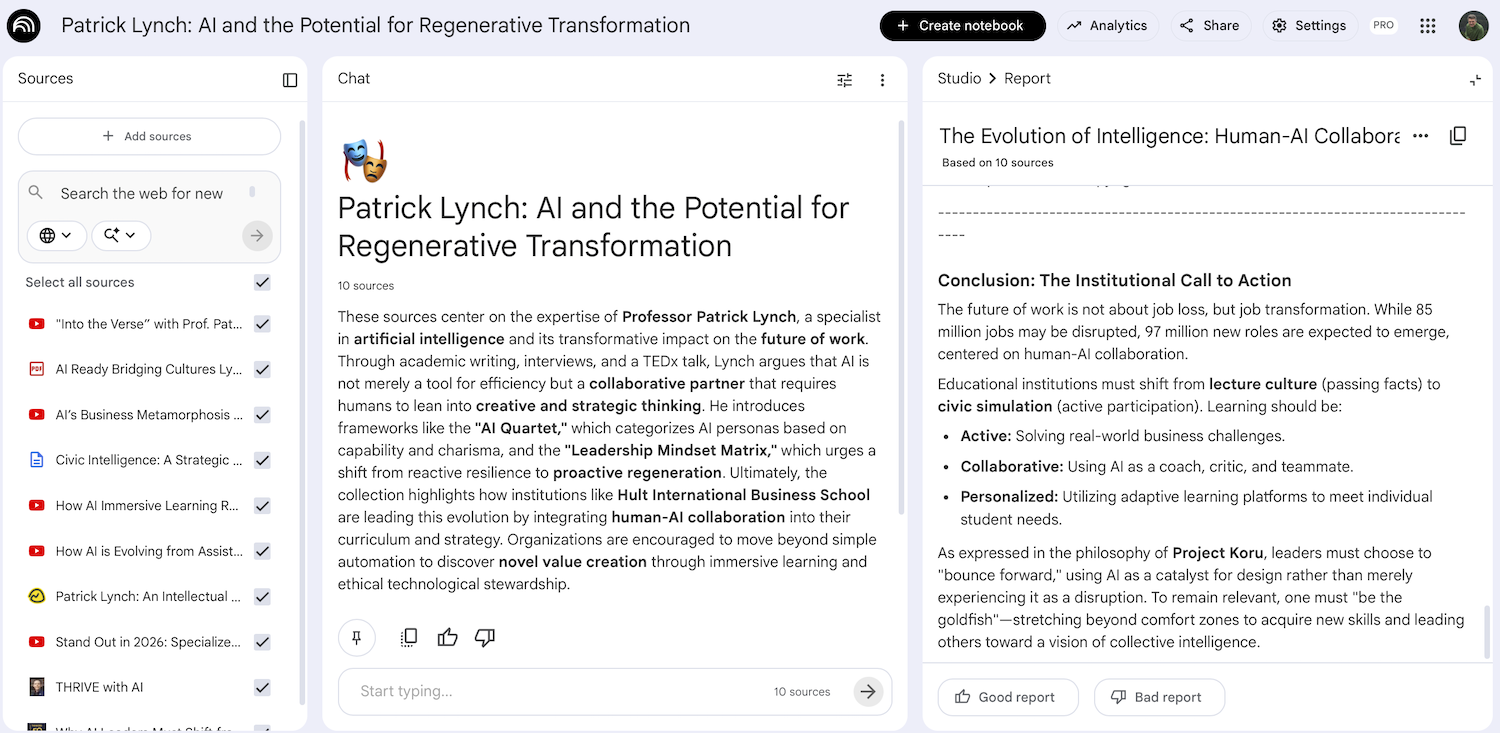
Our 90-minute conversation Monday night in Zoom will enable us to upload approximately 14,000 more words to this aggregation of Lynch’s knowledge, increasing the range and timeliness of his aggregated thinking. That’s when we’ll generate the draft we’ll invite Lynch to review and with his signoff publish.
Introducing Patrick Lynch
Thanks to Smartacus for generating the following, which I’ll read in opening our conversation Monday night:
When we talk about artificial intelligence, we often frame it as a technological story — faster tools, smarter software, new efficiencies. But what Patrick Lynch helps us see is that the real shift runs deeper. AI is not simply changing what we use. It is changing how we work, how we lead, and how institutions understand their purpose.
We are entering a moment in which intelligence itself is becoming infrastructural. For decades, organizations defined their mission around gathering, storing, and distributing information. Today, that function is increasingly automated. The emerging challenge is no longer access to knowledge, but the ability to interpret it, apply it, and act on it wisely. In this new landscape, success belongs to individuals and communities that learn to combine human judgment with machine capability — not defensively, but creatively.
Patrick’s work focuses on this transition from resilience to regeneration. A resilient organization uses AI to patch problems and preserve continuity. A regenerative one asks a more ambitious question: what new value becomes possible when humans and intelligent systems collaborate?
That shift reframes AI not as a tool or threat, but as a new kind of workforce — one that must be managed, integrated, and guided with care.
This conversation invites us to explore what that future demands. What skills matter when creativity, empathy, and critical thinking become more valuable than routine expertise? How do leaders manage teams that include both people and algorithms? How must our schools, civic institutions, and communities evolve if their role is no longer to distribute information, but to cultivate discernment?
How can we build an architecture of trust?
Patrick Lynch helps us navigate these questions not with alarmism, but with clarity. He challenges us to move beyond simply adapting to technological change and instead to design institutions capable of thinking, learning, and evolving alongside it.
Tonight’s conversation is an opportunity to consider what that means for our work, our organizations, and our civic life — and how we might begin, together, to move not just faster, but forward.