
TORCH DINNER
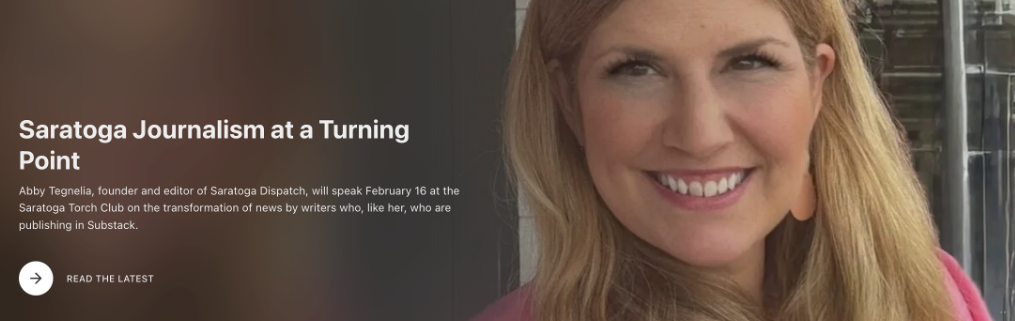
A Constellation of Independent Voices
Local journalism is undergoing the most consequential transformation since the rise of mass-circulation newspapers. Print, the default vehicle for civic information since the 1600s, no longer occupies that role, and it is not returning. At the same time, traditional newsrooms continue to contract, leaving many communities with less coverage, less accountability, and fewer shared sources of public knowledge.
What is emerging in its place is not a single new institution, but a constellation of independent voices—publishers, writers, and civic observers—using Substack to rebuild local journalism from the ground up. At the next meeting of the Saratoga Torch Club Monday, February 16 at the Saratoga Springs Holiday Inn, we’ll get a first-hand perspective on this emerging media environment with Abby Tegnelia, founder and editor of Saratoga Dispatch, the Substack-based local news publication she calls “the future of daily news in the Spa City.”
“It’s a place for insider info about the city you love from a journalist you know, sent straight to readers’ inboxes with original reporting and commentary,” she says.
Tegnelia built her career in newspapers and magazines—most recently at Saratoga Living—and as late as 2024 was publicly defending the enduring value of print.“But nostalgia is not a strategy,” she says. “Reader behavior has changed permanently. Digital formats offer flexibility, accessibility, and immediacy that print cannot match, and they increasingly support audio and conversational forms of storytelling that align with how people actually consume information today.”
Tegnelia regards Substack as the leading entry in the emerging infrastructure of independent journalism.Success, she explains, depends less on volume than on voice—”on identifying stories others are not telling and building a direct relationship with readers.”“The business realities of this model are frank and unromantic: growth and audience scale matter, understanding digital metrics is now as essential as reporting itself, and—most challenging—many writers have little experience with monetization. Even after they find their audience, how do they survive financially?”
Tegnelia also will explore of the most unsettled questions facing journalism today: the role of artificial intelligence. She draws a sharp distinction between AI as a business tool and AI as a writer. She rejects the use of AI to generate prose, arguing that voice, judgment, and personality are the irreducible core of journalism.
At the same time, she acknowledges using AI daily for tasks that improve efficiency and consistency, from headline constraints to style enforcement. Others in the discussion frame AI as a tool for organizing, synthesizing, and refining human knowledge—useful when bounded by transparency and human authority, dangerous when treated as a substitute for it.