

Winning Strategies to Succeed in
College and in Life
A Civic Conversation with Philip A. Glotzbach
Human and Artificial
Intelligence Working Together
Join us Monday, February 23 from 7 to 8:30 p.m. for a far-ranging conversation with Skidmore College President Emeritus Philip A. Glotzbach.
We’ll meet in Zoom. Admission is free.

College as Preparation for Thoughtful Leadership
The campus of Skidmore College does not announce its philosophy in bronze. It speaks instead through the pathways that curve toward one another, through windows that refuse to hide a laboratory from a rehearsal hall, through buildings that seem to eavesdrop on their neighbors. If a college can possess a personality, Skidmore’s is inquisitive and slightly unruly—a place designed to encourage the useful accident.
For nearly two decades Philip A. Glotzbach served as the chief steward of that personality. When he became Skidmore’s seventh president in 2003, he inherited more than budgets and buildings. He inherited a sentence written in 1961 by Josephine Young Case, whose Charge to the Architects asked for a campus that would give students “freedom in the mind and horizon in the spirit.”
Glotzbach retired in 2017 as President Emeritus, but the questions that animated his tenure have followed him into a new chapter of civic and intellectual life—one marked by continued writing, mentoring, and an ongoing engagement with the national conversation about the future of liberal education. Friends say he now enjoys the luxury of asking the questions rather than answering them, yet he remains, unmistakably, an educator at heart.
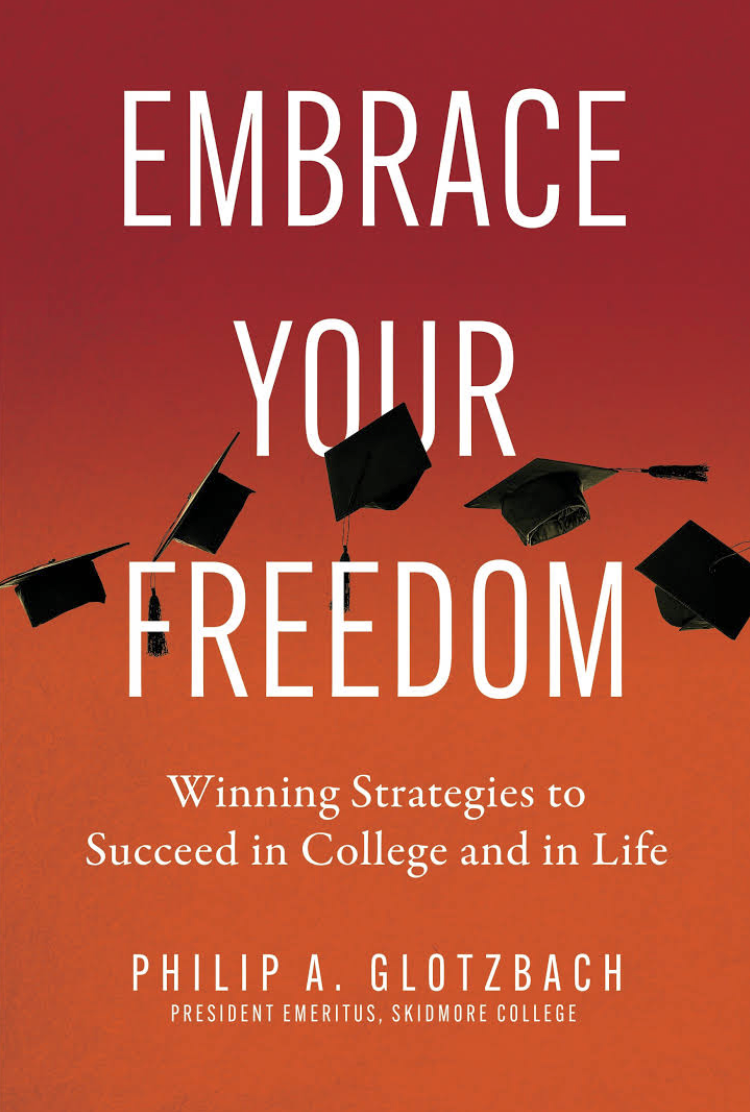
In his newly published book, Embrace Your Freedom: Winning Strategies for Success in College and Life, Glotzbach begins from a deceptively simple premise: success is less about talent than about habits. He argues that the students who thrive are not necessarily the smartest in the room but the ones who learn how to manage their time, attention, and relationships with intention. College, in his framing, is not just an academic experience but a laboratory for building the practices—curiosity, persistence, and reflective judgment—that shape a lifetime of achievement.
A second central theme is the importance of engagement. Glotzbach emphasizes that meaningful learning happens when students step beyond passive participation and take ownership of their education—seeking mentors, asking questions, joining communities, and embracing intellectual risk. He presents college as a network of opportunities rather than a checklist of requirements, urging students to cultivate relationships with faculty, peers, and institutions that will support their growth long after graduation.
He also stresses the role of character and purpose. Academic success alone, he suggests, is insufficient without a developing sense of values, responsibility, and contribution. Students are encouraged to think early about the kind of person they hope to become, not just the career they hope to secure. By connecting education to service, citizenship, and ethical reflection, Glotzbach frames college as preparation for thoughtful leadership in a complex and rapidly changing world.
Taken together, the book offers a roadmap for approaching both college and life as ongoing learning projects. Readers can expect practical guidance on navigating academic demands, making wise choices about opportunities and commitments, and cultivating resilience in the face of setbacks. More broadly, Glotzbach’s message is that success emerges from intentional living—choosing habits, relationships, and purposes that align with one’s deeper aspirations.
The Power of AI
Google’s NotebookLMis one of four AI tools that Saratoga AI is demonstrating in researching, recording, transcribing, organizing. and writing Civic Conversations. It enables us to extract information at any length and in any form as many as 50 aggregated sources. For our convesation with Philip Glotzbach, we uploaded 17.