The Man Who Became a Monument
George Washington’s regard for horses was central to
how he lived and led, John Oliver tells us
George Washington is everywhere and nowhere at once—his face in our wallets, his name etched into cities, bridges, and institutions, his story told so often it has hardened into something like certainty. And yet, as John Oliver observed in our conversation Monday night, that familiarity conceals a deeper problem. “He seemed the most opaque of all the founders,” Oliver said, pointing to a figure we recognize instantly but rarely understand. “You couldn’t really get a sense of who he was… we don’t have a lot of quotes from him.”
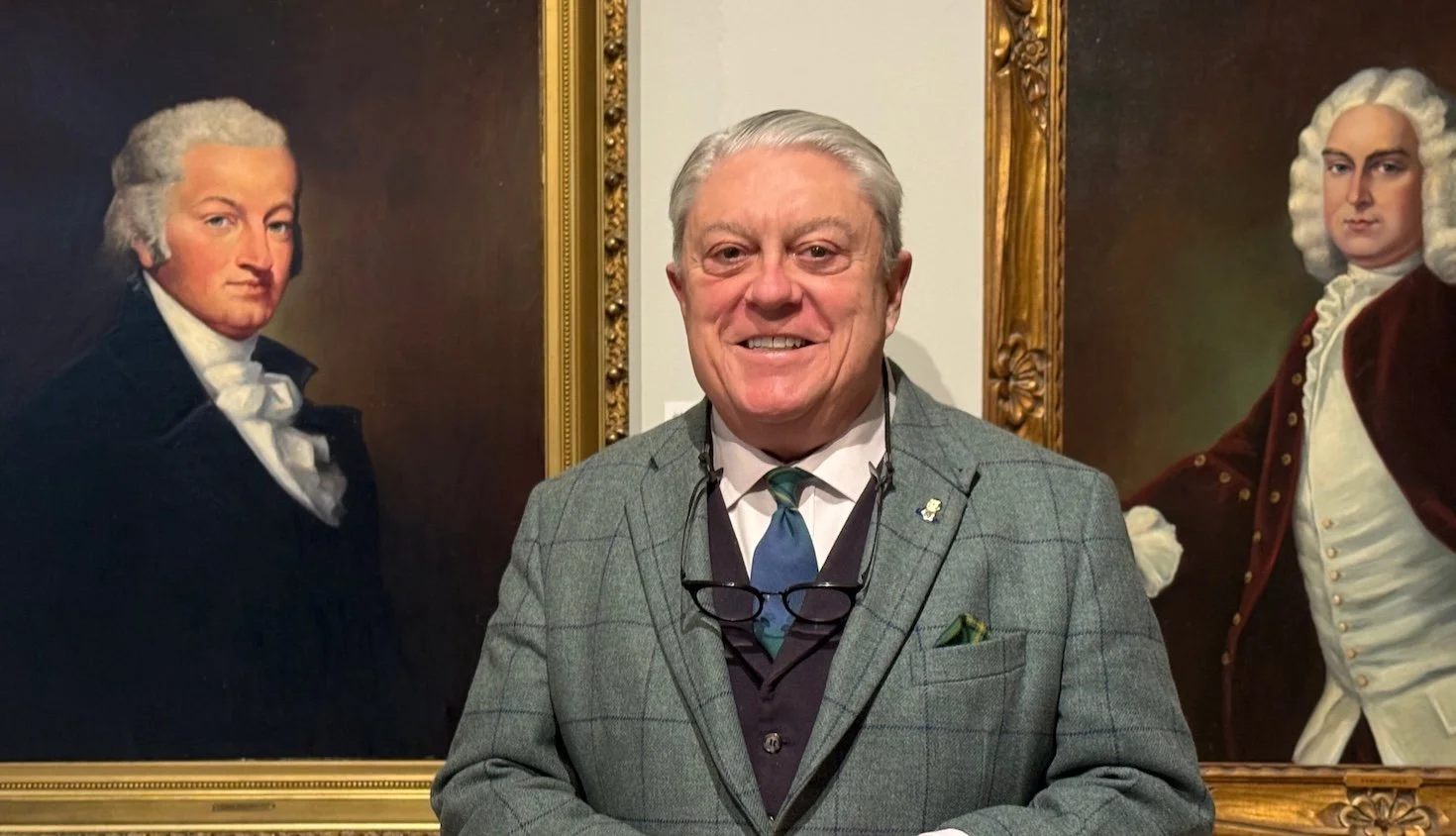
John Oliver at the National Racing Museum, where he volunteers as a docent.
For Oliver, this absence is not a void but an invitation. It is what drew him into Washington’s life and what continues to hold his attention—not only as a reader of history, but as someone who spends his time interpreting another kind of American legacy as a docent at the National Museum of Racing and Hall of Fame.
There, among the stories of horses and riders, of discipline and form, of presence and performance, Oliver encounters a dimension of Washington that often goes unspoken but was central to how he lived and led.
“He was raised as an English gentleman and fox hunting was a major component of that education,” Oliver told us in our Zoom conversation Monday. “It taught him how to 'ride to the hounds', leap over every imaginable barrier and, most important, how to fight in the saddle. He used these skills throughout his entire life.”
Washington was fiercely concerned about his legacy, “always burnishing his image and trying to make his brand a little snappier than it was,” Oliver said. That instinct, he argues, was not confined to the written record—to diaries revised or letters carefully composed—but extended into the physical theater of public life. Washington understood how to be seen. And nowhere was that more evident than in the saddle.
Washington, Oliver suggests, was not merely competent on horseback; he was exceptional. The kind of rider who commanded attention not by flourish, but by control. The kind of figure who could enter a city like Philadelphia and communicate authority before uttering a word. In an age before mass media, before photography or broadcast, this mattered. The horse was not transportation. It was amplification.
Oliver doesn’t romanticize this so much as recognize its strategic value.
“He was actively shaping how that life would be remembered,” he said, describing Washington’s lifelong attention to how events were recorded and retold. “He wrote a diary… and as the news changed and as conditions changed, he changed the diary.” That same impulse—to revise, refine, and control—extended beyond the page. When Washington rode, he was not simply moving through space. He was staging himself within it.
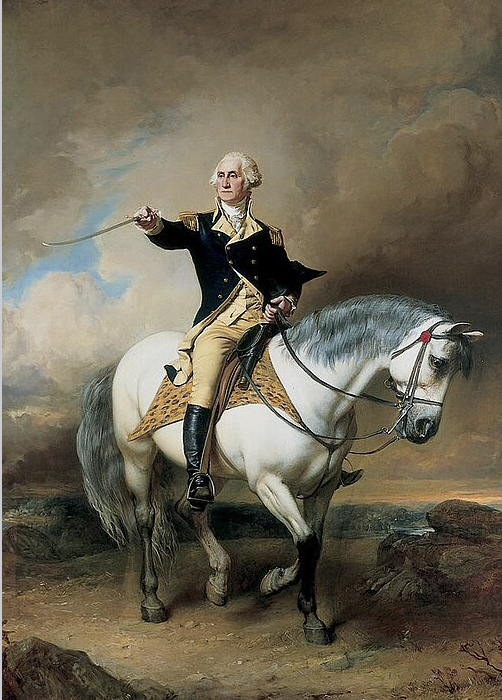
Blueskin was one of two horses Washington rode during the American Revolution, preferred for portraits for his white hair coat.
That idea resonates in a place like Saratoga, where the relationship between rider and horse is still understood as a kind of language. At the Racing Museum, Oliver helps visitors see what might otherwise be missed: the way a rider sits a horse, the way a horse responds, the mutual discipline required to move as one. It is not difficult, standing there, to imagine Washington in similar terms—not as a distant marble figure, but as a man in motion, aware that people were watching and that what they saw would become part of the story.
“The English… created a hero out of Washington,” Oliver said, recalling the episode that first propelled him into public view. A young officer sent to observe French activity instead found himself at the center of a violent confrontation.
“They attacked the French, slaughtered them… and somebody put an ax in the French commander’s head.” The reality was messy, even alarming. But what followed was something else entirely. “He became a household name on both sides of the Atlantic,” Oliver said, not because of what had happened, but because of how it was framed.
That pattern—event, followed by interpretation, followed by elevation—became the rhythm of Washington’s life. And in Oliver’s telling, Washington was not merely the subject of that process but an active participant in it. “He was fiercely concerned about his legacy,” he repeated, emphasizing the point. “Always burnishing his image.” The phrase feels almost contemporary, as if Washington were managing not just a reputation but a brand.
But if Washington was careful about how he appeared, he was also aware of how fragile that appearance could be.
“He didn’t want any of these positions,” Oliver said, referring to Washington’s roles as commander of the Continental Army, presiding officer at the Constitutional Convention, and eventually president. “He was terrified that this whole thing wasn’t going to work.” That fear, Oliver suggests, was not abstract. It was tied directly to Washington’s sense of how history would judge him.
That sense of precariousness reframes even his most iconic moments. “He had to borrow 600 pounds to get to New York to be sworn in,” Oliver noted, describing a detail that feels almost absurd given what we know of the outcome. The first president of the United States, unable to afford the journey to his own inauguration. It is a reminder that the image of Washington—composed, authoritative, mounted—was often at odds with the realities he was navigating behind the scenes.
And yet, when he appeared in public, those realities were invisible. What people saw instead was the figure on horseback: steady, controlled, seemingly inevitable. It is here that Oliver’s dual interests—in Washington and in the culture of horsemanship preserved at the Racing Museum—begin to converge. Both are concerned with how presence is constructed. Both recognize that what is seen can be as powerful as what is said.
“We like to think all these Enlightenment men got together,” Oliver said, reflecting on the founding itself. “It was more of a kind of a scrum of contending egos.” The image is almost comic, a cluster of ambitious men jostling for position. But Washington, in Oliver’s telling, stood apart not because he was above that contest, but because he understood how to navigate it—how to present himself in a way that could unify, or at least stabilize, the chaos around him.
That presentation was not accidental. It was practiced. Refined. Performed. And the horse, Oliver suggests, was central to it. Not as ornament, but as instrument. A way of embodying the qualities Washington needed to project: control, discipline, composure under pressure.
“George Washington is the man who became a monument,” Oliver said, quoting a historian whose line captures the arc of Washington’s transformation. But Oliver is less interested in the monument than in the man who preceded it—the one who worried, calculated, adjusted, and, above all, paid attention to how he would be seen.
Imagine Washington riding into Philadelphia, the streets alive with anticipation, the figure of Washington approaching, mounted and composed. Before he speaks, before he acts, he is already communicating something. Authority. Control. Purpose.
That image, once seen, is difficult to unsee. It connects the abstract Washington of textbooks to a physical reality that feels immediate and human. It bridges the distance between the founding era and the present, between the parade grounds of the eighteenth century and the paddocks of Saratoga.
What Oliver offers, ultimately, is not a debunking of Washington but a reanimation. By restoring the elements that have been smoothed away—fear, ambition, calculation, performance—he makes Washington legible again. Not as a monument, but as a man who understood, perhaps better than anyone of his time, that history is not just written. It is seen.
And sometimes, it is seen from horseback.