Remembering Peter Finley’s Fight for the Rule of Law
A Conversation with Greg Veitch
In marking the centennial of Peter Finley's courageous stand for the rule of law and the Heffernan Investigation it set in motion, we invited historian and former Saratoga Springs Police Chief Greg Veitch to rejoin us in Zoom and fill us in further. In the Smartacus Story Accelerator, we quickly boiled down the 14,000-word transcript that resulted from our conversation to the 2000 words you’ll find below.
A Family Story Becomes an Obsession
People often assume I wrote these books because I was the police chief. That certainly gave me access to records and experience as an investigator, but that's not where the story begins.
It starts when I was a little kid.

Greg Veitch joined the Saratoga Torch Club for the third time to further this project
My family was preparing to sell the Old Bryan Inn, our family homestead, when someone told me a story about my great-grandfather. He had been riding in a car when a man in the back seat was shot. The wounded man was dumped at the hospital, and when the police questioned my great-grandfather, he simply said, "I was sitting in the front seat. They shot him in the back seat. I didn't see nothing. I don't know what happened."
That story stayed with me.
I wasn't really allowed around my great-grandfather. He spent time with gangsters, and my grandfather wanted nothing to do with that world. My father didn't want me around him either. But the story never disappeared.
Years later, after I became a Saratoga Springs police officer, I was looking through the department archives. I asked what the oldest case file was, opened it, and discovered it was the Perillo murder—a man shot and abandoned at the hospital in 1936. Members of the Montreal Mafia had finally caught up with him after waiting more than a decade for revenge.
Suddenly I realized I'd stumbled onto something remarkable.
I began researching the officers, suspects, and witnesses in that file. One investigation led naturally to another, and before long I was giving presentations at the local history museum.
After one talk, a man I'd noticed standing quietly in the back walked straight up to me and said, "You should write a book."
Then he turned around and walked away.
At the time I was still working for the police department. Writing a book hadn't really occurred to me. But I realized no one had ever brought together the intertwined history of Saratoga's gambling, organized crime, politics, and corruption.
So I started writing.
About three hundred pages into the manuscript I realized nobody was going to buy an eight-hundred-page history of Saratoga. I split it into two books and told my wife that if the first one actually made a profit, I'd write the second.
Fortunately, readers proved there was an audience.
Looking back, it's remarkable how one family anecdote changed everything. If nobody had ever told me that story about my great-grandfather, I probably would have lived my entire life in Saratoga without ever discovering this history.
The Saratoga Way
People sometimes ask whether the corruption described in A Gangster's Paradise began with the men who dominate the story—Doc Leonard, Jim Leary, Patrick Rox, and Doc Farone.
I don't think they created it. I think they perfected it.
Gambling and vice had been part of Saratoga almost from the beginning. As a resort town, Saratoga attracted wealthy visitors who enjoyed wagering their money. Then John Morrissey established the racetrack and eventually controlled casino gambling as well.
Whenever reformers threatened that system, Morrissey would warn that he could simply move the racetrack somewhere else. The fear was always the same: without racing, Saratoga's economy would collapse.
Over time, the city accepted gambling as the price of prosperity. By the 1920s, Leonard and Leary had refined that arrangement into what I think of as the “Saratoga Way.”

This ChatGPT’s rendering of Doc Leonard seizing the D&H Railroad coal train.
Doc Leonard, as Commissioner of Public Safety, became the public face of local government. He was enormously popular. As a physician he already knew much of the community, but he also possessed remarkable political instincts.
During the coal shortage in the early 1920s, with winter approaching and families facing hardship, Leonard ordered police officers and firefighters to seize railroad cars loaded with coalthat were passing through Saratoga on their way to Canada. The coal was distributed throughout the city so people wouldn't freeze.
Whether people approved of the legality or not, they remembered who had helped them.
Jim Leary exercised a different kind of influence. He inherited much of his political education from Senator Edgar T. Brackett and became the strategist who understood how to build and maintain political alliances. He exerted influence throughout county government, including the sheriff's office and, to some extent, the district attorney.
For that system to work, however, the police also had to cooperate. Patrick Rox became indispensable because he demonstrated exactly that.
During the Heffernan Investigation, testimony showed that Detective Rox had been assigned to investigate gambling establishments. Witnesses said he entered places where gambling was plainly visible and emerged reporting he had found nothing. Later he testified that he had known these establishments for years, had visited them repeatedly, and had never observed gambling.
Viewed today, that testimony seems astonishing. But policing in 1926 was very different from policing today. There were no police academies, no specialized vice units, and much of policing was political. If no one complained, officers often did nothing.
These officers also lived in the same community as everyone else. They knew the business owners personally and understood that gambling supported local jobs. For decades many Saratogians believed eliminating gambling would destroy the city's economy.
Ironically, when gambling finally disappeared in the 1950s, Saratoga did experience a long economic decline before reinventing itself decades later.
Doc Farone represented another piece of the system. During the Heffernan Investigation he was only beginning to consolidate power, which is why he appears only briefly in that story. Over the following decades, however, he became one of the central figures in Saratoga's organized crime network, managing local gambling and bootlegging operations while serving as a bridge between local interests and national organized crime.
Together these men didn't invent Saratoga's accommodation with gambling. They perfected a system that had evolved over generations.
When Peter Finley Forced the Issue
By the summer of 1926, Peter Finley concluded that complaining to local officials was pointless. He understood that if reform was going to happen, it would have to come from Albany.
As president of the Saratoga Taxpayers Association, he understood how power worked. Local officials had little incentive to challenge a system that so many residents accepted and so many businesses depended upon. Gambling had become part of Saratoga's identity. It generated jobs, attracted visitors, and, in the minds of many citizens, underpinned the city's prosperity. Speaking out against it meant challenging not only elected officials but much of public opinion as well.
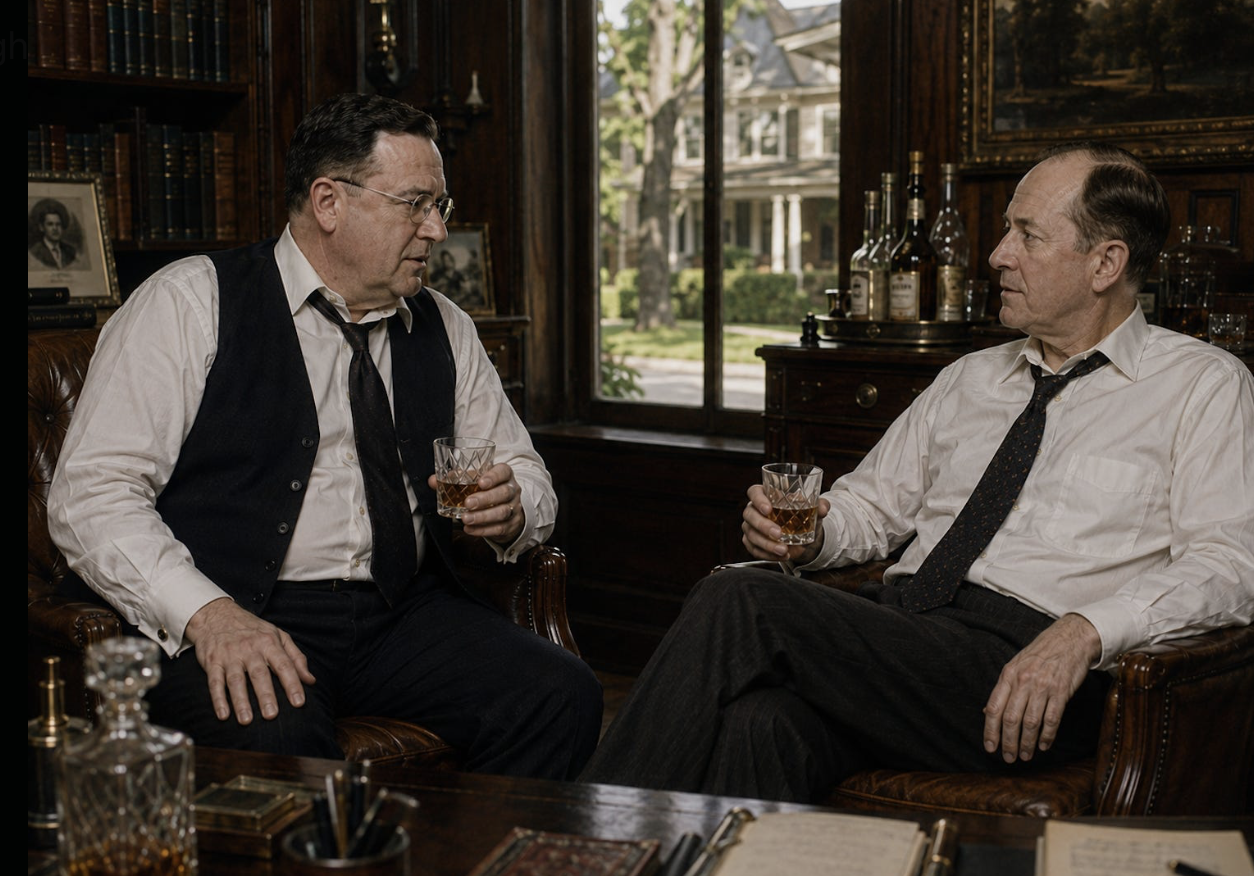
This is ChatGPT’s rendering of Gov. Al Smith and Doc Leonard discussing the complaint Leonard had just received from Peter Finley on July 15, the week before he sent the same complaint directly to Smith.
That's what made Finley's campaign so remarkable. His real insight was recognizing that the only person with enough authority to break the deadlock was Governor Al Smith. Just as important, he understood how to compel the governor to act.
Finley didn't simply accuse local officials of failing to enforce the law. He reminded Smith that the governor himself had visited Saratoga's gambling establishments. The implication was impossible to miss. This wasn't someone else's problem. Smith already knew what existed. That changed everything.
Had the governor merely received another complaint about gambling, he might well have set it aside. Instead, Finley effectively challenged him to respond to conditions he had seen with his own eyes.
Smith answered by invoking the Moreland Act. That decision shaped everything that followed.
A Moreland Act investigation isn't a criminal prosecution. It's an executive inquiry authorized by the governor to determine whether public officials have faithfully performed their duties. Witnesses can be subpoenaed, documents gathered, and testimony taken, but the proceeding is designed to establish facts rather than determine criminal guilt.
That distinction gave Finley unusual freedom. In many respects, he became the prosecutor. He had to locate witnesses, assemble evidence, and build the case that Saratoga's officials had knowingly tolerated widespread violations of the law. Justice Christopher Heffernan's responsibility wasn't to send people to prison. His job was to determine what had happened and recommend whether public officials deserved to remain in office.
The consequences would be political rather than criminal. They would reshape Saratoga government.
Inside the Heffernan Hearings
Whenever people ask what stands out most from the hearings, I always come back to one witness: Jules Formel. If someone we were writing this as a television series, Formel would certainly be one of our main characters.
Years before the Heffernan Investigation, Formel had been caught in the gambling raids at 210 South Broadway and actually served time in prison. Those earlier proceedings uncovered the famous "divvy sheet," a document that purported to show how gambling profits were distributed, with District Attorney Charles Andrus's name connected to the arrangement.
When Formel appeared before Heffernan in 1926, he provided many of the missing links. He testified that he had acted as an intermediary between Arnold Rothstein and Andrus and claimed he had been promised compensation for arranging the relationship before being cheated out of most of what he was owed.
Of course, Formel presented an obvious credibility problem. He was a convicted gambler. In a criminal courtroom, his testimony would almost certainly have been attacked from every direction. But Heffernan wasn't conducting a criminal trial. His task was to assemble the fullest possible picture of how Saratoga's government actually functioned, and Formel's testimony became one important piece of that larger picture.
He wasn't alone. Finley called private investigators, former police officers, and other witnesses who described gambling operating openly throughout the city. Then came testimony from the police themselves. That's where the hearings took on an almost surreal quality.
One witness described entering a gambling establishment where the betting odds were being written on a chalkboard by a one-legged bookmaker. The defense answered by producing a one-legged man who testified that he had frequented the establishment for years without ever seeing gambling.
You almost couldn't script a scene like that.
Reading the transcript today, you can almost picture Justice Heffernan wondering whether anyone expected him to believe what he was hearing. As the hearings progressed, he became increasingly engaged, questioning witnesses himself and probing testimony that struck him as implausible. By the time he completed his report, he concluded that some police testimony was so inconsistent it suggested possible perjury.
Even then, however, no one went to prison. That was never the purpose of the proceeding.
Heffernan issued what the Moreland Act required: findings of fact and recommendations to the governor. Those recommendations left Al Smith with an extraordinarily difficult decision.
Doc Leonard, Smith's friend and personal physician, resigned before the governor acted. Sheriff Arthur Wilmot and District Attorney Charles Andrus did not. Smith removed them from office.
Leonard's resignation proved politically astute. Because he stepped down before formal removal, he remained eligible to seek office again and eventually returned to public life.
As a historian, I can document what happened. The hearings concluded. Heffernan issued his report.Leonard resigned. Smith removed Wilmot and Andrus. Leonard later returned to office.
What I can't document are the conversations that took place behind closed doors. Did someone quietly tell Leonard that resignation offered his only realistic path back to public service? It seems entirely plausible, and over the years I've heard family stories suggesting discussions like that occurred. But family stories aren't documentary evidence.
One of the responsibilities of history is recognizing the difference between what can be proven and what can only be inferred. That's a line I try very hard not to cross.
Why the Story Still Matters
Researching Saratoga's gambling era taught me that history is never really finished. When I began, I thought I was simply solving old mysteries. Instead, every answer opened another line of inquiry. One document led to another witness, another newspaper account, another forgotten connection. That's what kept me working on these books for nearly a decade.
Now I watch artificial intelligence organize thousands of pages of research in minutes.
I'm still cautious about AI. Like any tool, it has limitations, and I'm not ready to embrace it uncritically. But I also recognize what it makes possible. Conversations like this can now be preserved, searched, connected to archival documents, and used to help future historians ask better questions than I could have imagined when I began my research.
I've written what I know. I also know I don't know everything. If another generation uses new tools to build on this work, that's exactly what historians have always done.
Years ago, Saratoga's city historian gave me a piece of advice I've never forgotten. "Every time somebody touches history, it becomes new again."
I believe that's true. Every generation asks different questions. Every generation notices different connections. Every generation finds new meaning in familiar events. That's why the story of 1926 still matters.
It's about much more than gambling. It's about political power, public accountability, the compromises communities make in pursuit of prosperity, and the determination of one citizen to challenge an entrenched system.
Those aren't merely Saratoga's questions. They're questions every generation eventually has to answer.