Signs of Life at Saratoga’s Southern Gateway
On the site of a former gas station, the SoBro Conservancy is teaching us an important lesson: Nature returns when given the opportunity
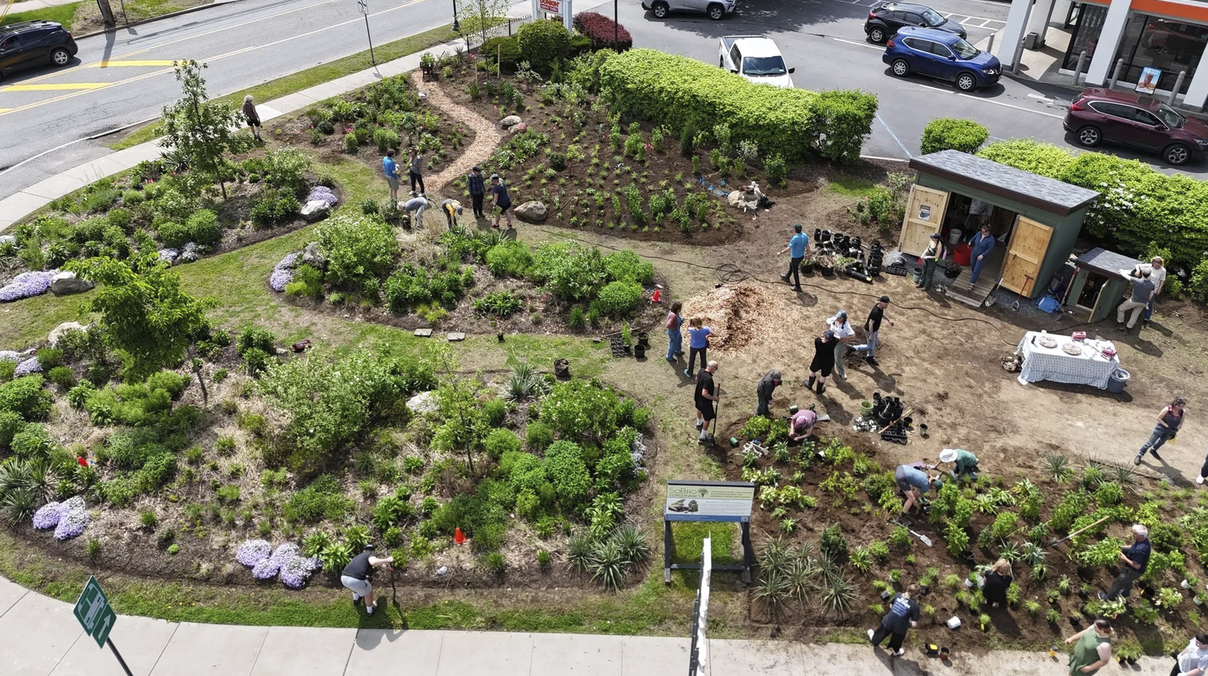
The SoBro Triangle, designed by Design Wild, sits at the intersection of South Broadway and Ballston Avenue. Here’s how it looked on Planting Day in May 2025.
On the summer solstice, the SoBro Conservancy marked an important milestone in the transformation of one of Saratoga Springs’ most overlooked corners. The installation of four interpretive signs at the SoBro Triangle signals a new phase for the project—not simply as a native garden, but as a place where residents can learn why native plants and biodiversity matter and how even small urban spaces can help restore it.
Situated at 209 South Broadway at the city’s southern gateway, where roughly 30,000 vehicles pass each day, the two-tenths-of-an-acre parcel sits in a neighborhood more often associated with traffic, fast-food restaurants, and commercial development than with ecological restoration. Yet over the past several years, SoBro’s ecological garden has become an unlikely demonstration of how nature can return when given the opportunity.
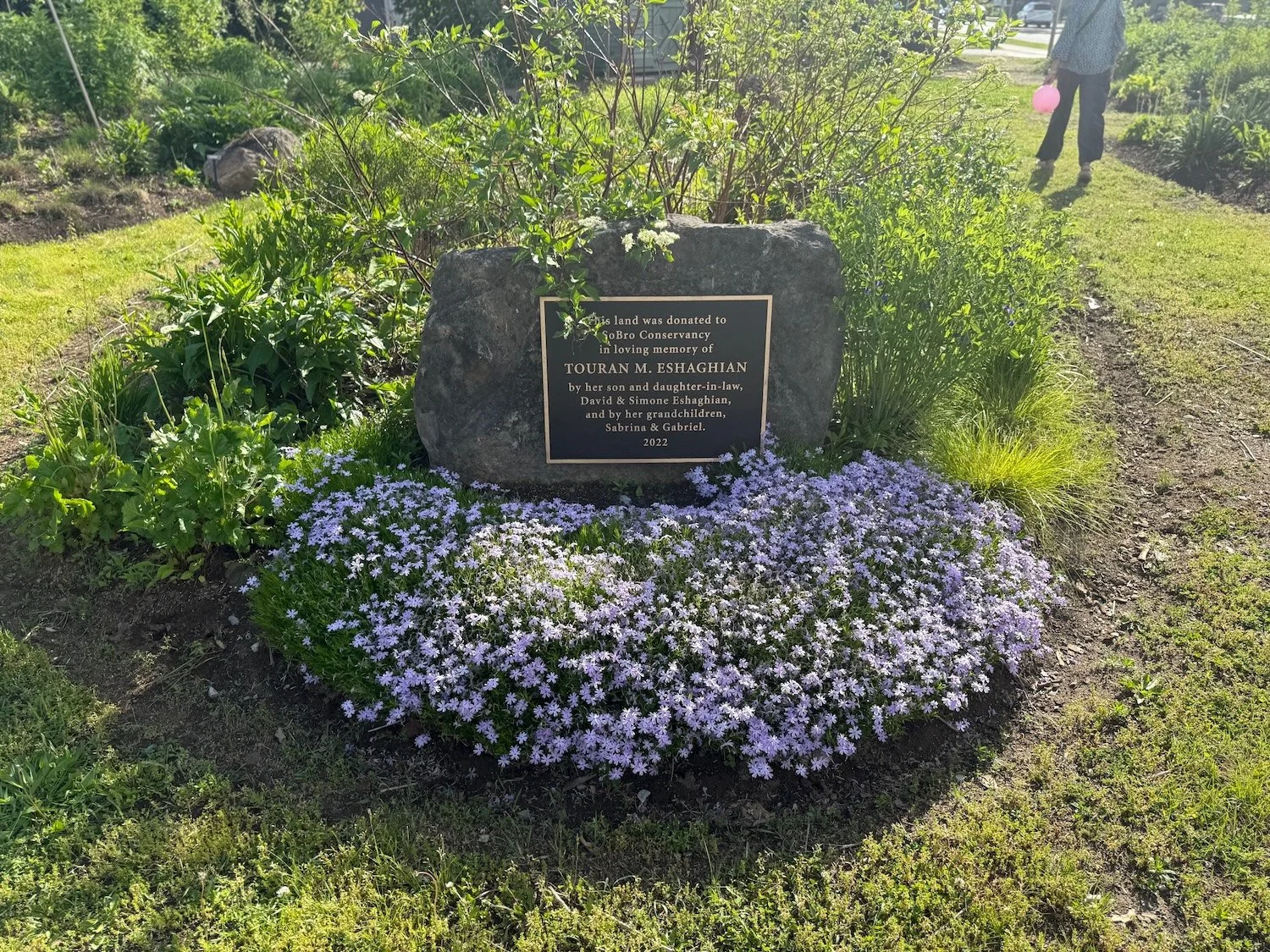
Formerly the site of a gas station that closed in 1999, the two-tenths-of-an-acre parcel was donated to the SoBro Conservancy in 2022 by David Eshaghian and his family.
For more than two decades, this parcel was a barren eyesore at the head of South Broadway, long viewed as one of Saratoga’s most challenging corridors. In 2012, the GAPS committee, convened by then-Commissioner John Franck and Supervisor Matt Veitch, to help revitalize South Broadway. One proposal was to regreen it into a parks district to capitalize on its proximity to the state park. Although the idea generated discussion, little changed on the ground for years.
SoBro Conservancy has taken a different approach. Rather than waiting for large-scale redevelopment to improve South Broadway, it has pursued a series of small, practical steps. A large, passionate volunteer community of SoBro leaders, garden worker bees, and donors have joined together to tackle this transformative effort. The result is a project that connects neighborhood beautification with a broader ecological mission: restoring native habitat, increasing biodiversity, and helping residents understand their role in the larger web of life.
The new interpretive signs expand the project’s educational mission. Located along a heavily traveled pedestrian corridor between the Stonequist and Raymond Watkins apartments and Broadway, the new interpretive signs explain the ecological ideas behind the garden in accessible language. They help visitors understand why native plants matter, why pollinators are important, and why a landscape that appears less manicured can actually be more productive and biologically rich.
In this sense, the signs are as important as the plants themselves. They transform the site from a garden people pass by into a place where people can learn.
What the ‘Splat-o-meter’ Tells Us
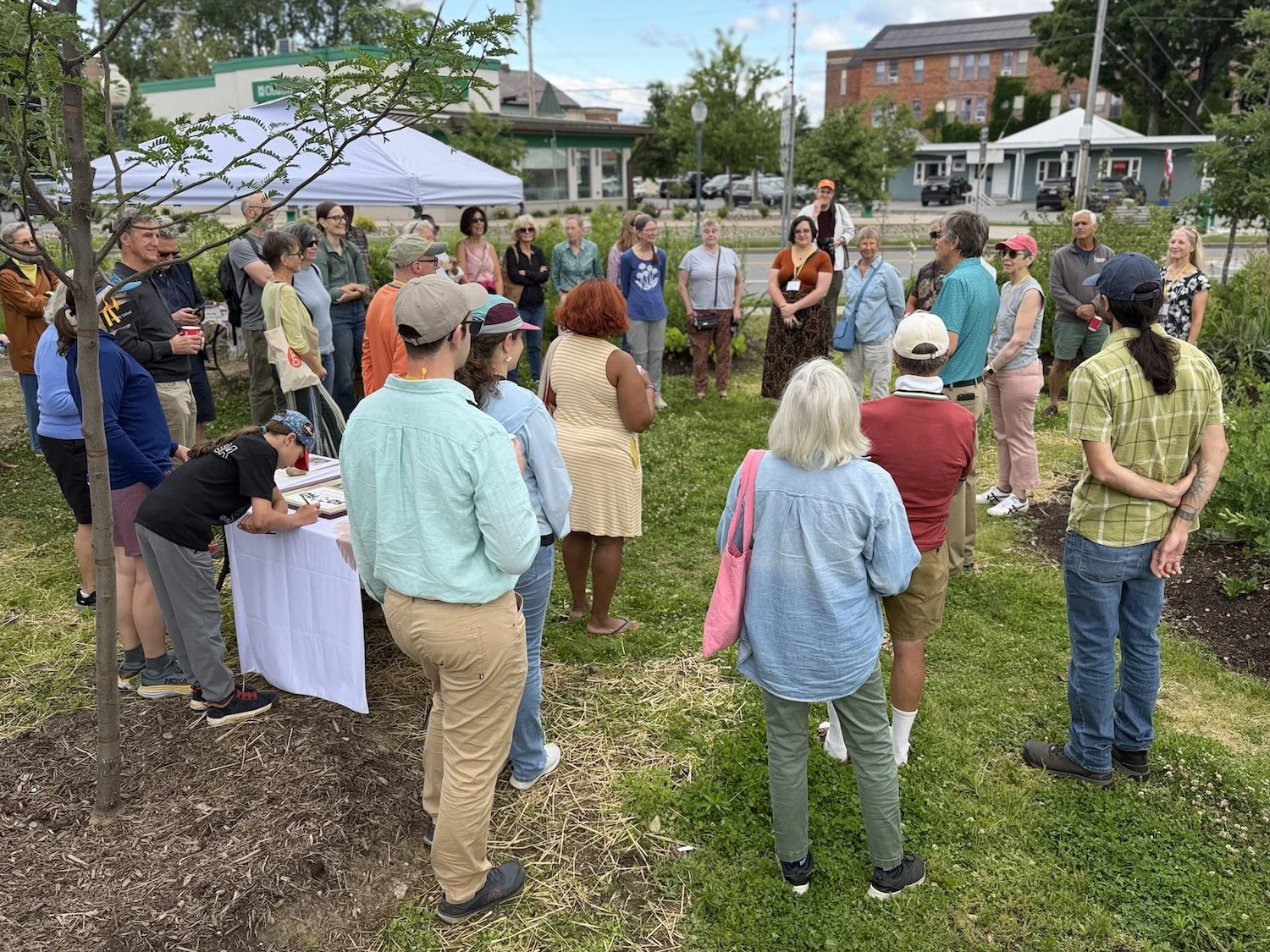
SoBro Conservancy supporters gathered at the SoBro Triangle for a summer solstice celebration, including the unveiling of four new interpretive signs and brief remarks that highlighted the role of native plants in restoring biodiversity at Saratoga Springs' southern gateway.
Tom Denny, one of the project’s leading advocates, often begins with a simple observation.
Many people remember a time when a summer road trip required frequent stops to clean insects from a car windshield. Wings, thoraxes, and splattered bugs were an unavoidable part of driving through the countryside.
Today, windshields are noticeably cleaner. Denny calls this the “Splat-o-meter.”
For him, our windshields provide powerful evidence that insect populations have declined dramatically over recent decades. What might seem like a minor convenience is actually evidence of a larger ecological shift.
Why is this important? As biologist E.O. Wilson famously observed, invertebrates are “the little things that run the world.” They pollinate plants, recycle nutrients, feed birds, and support countless other forms of life. When insect populations decline, the effects ripple throughout entire ecosystems.
Fireflies offer another particularly visible example. Once a familiar, magical feature of summer evenings, they have become increasingly scarce. Their disappearance serves as a reminder that ecological change is often happening quietly, just beyond the edge of everyday attention.
For SoBro Conservancy, these trends point toward a simple conclusion: restoring nature cannot be left entirely to distant wilderness areas or government policy. It must also happen in neighborhoods, parks, backyards, and overlooked urban spaces. This recognition of the cumulative power of small steps is part of a larger movement championed by entomologist Doug Tallamy through his Homegrown National Park initiative.
From Ornament to Infrastructure
The biodiverse, native garden at SoBro Triangle shares many values with another restorative initiative in Saratoga, Sustainable Saratoga’s Urban Forestry Project, best known for Tree Toga, its annual community tree-planting event.
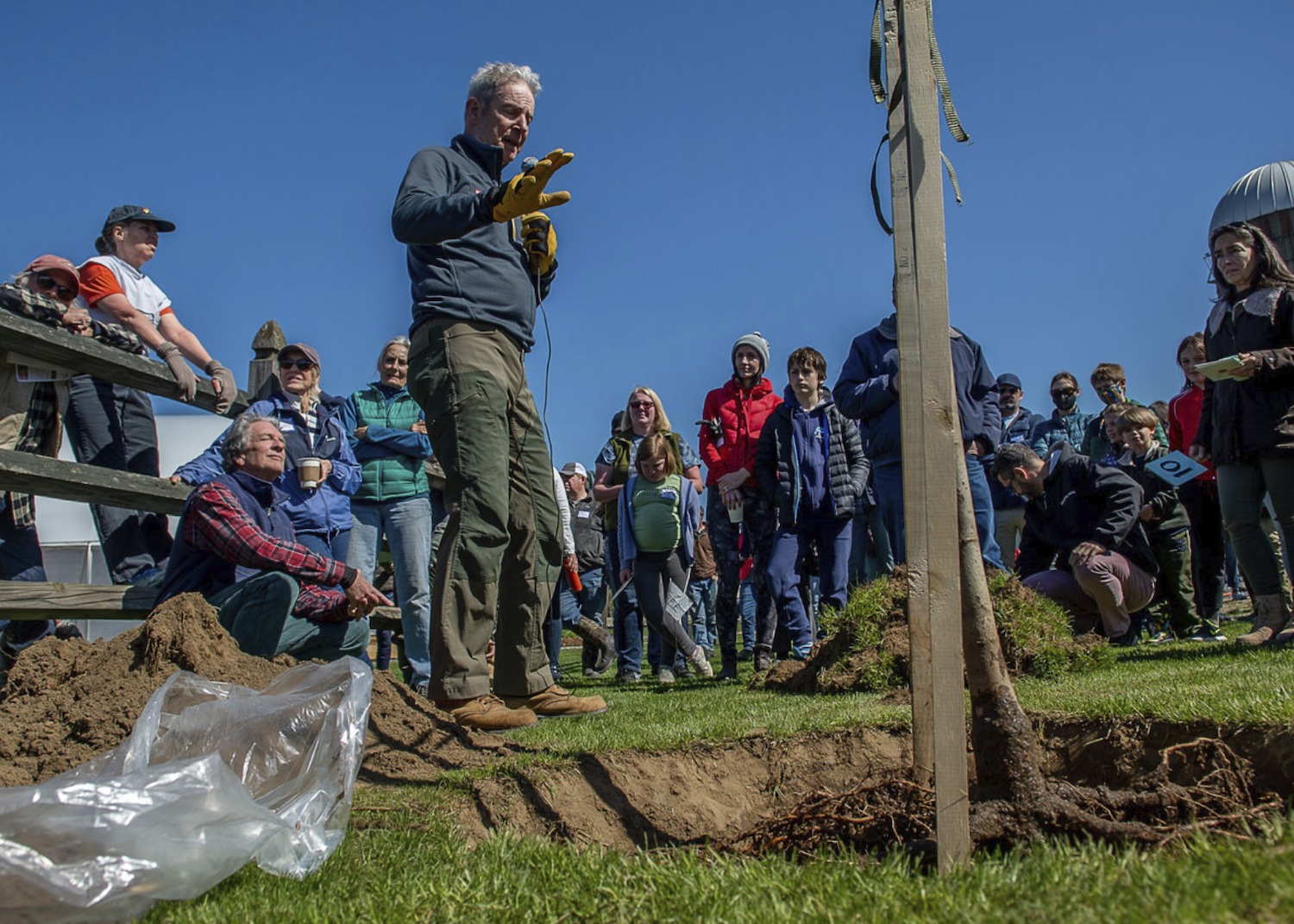
Tree Toga planting lesson by Rick Fenton of Sustainable Saratoga.
One of the most important lessons to emerge from Saratoga Springs’ 2012 Tree Inventory, conducted by Sustainable Saratoga, was that many of the city’s trees were providing far less ecological value than residents assumed.
The inventory found that nearly 40 percent of Saratoga’s street trees were invasive non-native species, Norway maples (32%) and Callery pear (7%). Native trees have co-evolved with local pollinators, birds, and other wildlife as part of a functioning food web in the native ecosystem. Non-native trees do not support the local ecosystem to the same extent. The inventory also revealed that more than half of Saratoga’s street trees belonged to a single genus, maples. Such a lack of diversity leaves an urban forest vulnerable to pests, disease, and ecological decline. Sustainable Saratoga’s inventory and advocacy led the city to revise its tree planting policies, shifting to a diverse list of native trees.
The findings helped reinforce a growing understanding among local environmental advocates: trees are not merely decoration. They are functional, both as cost-effective urban infrastructure and as habitat.
A healthy urban forest absorbs stormwater, cools neighborhoods, stores carbon, improves air quality, and supports wildlife. The choice of species matters. Native trees and plants sustain insects, birds, and pollinators in ways that many alien, ornamental species cannot.
This insight also lies at the heart of the SoBro project.
Rather than focusing solely on appearance, the SoBro Triangle garden emphasizes native species that contribute to ecological function. The goal is not simply to create a prettier landscape but a more productive one.
The New Beautiful
Perhaps the strongest argument for the project comes from the results themselves.
The first major plantings took place in May 2024. Within two months, bumblebees, wasps, and monarch butterflies had already begun appearing at the site.
For Denny, the lesson is simple. “If you plant it, they will come.”
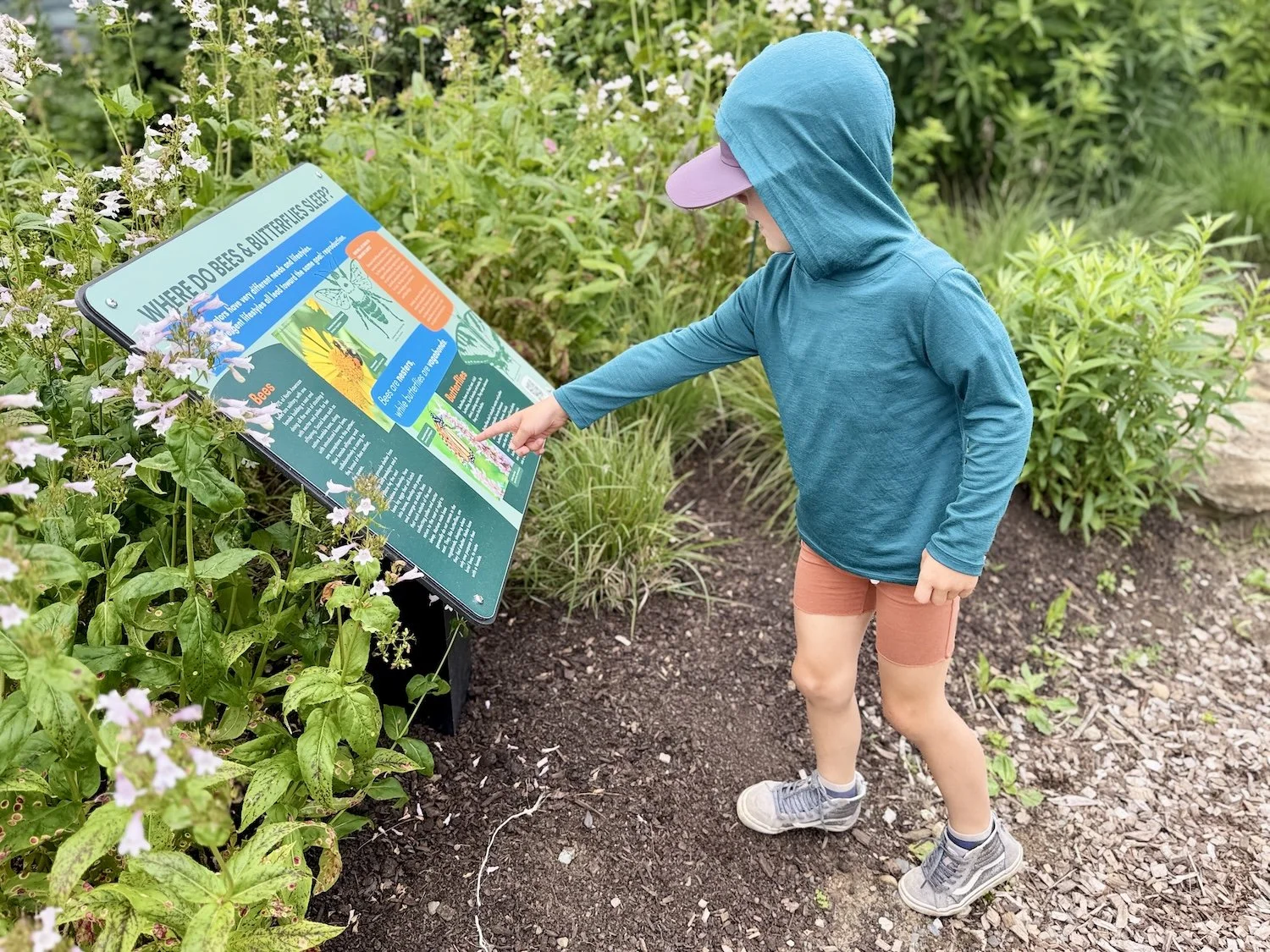
The new interpretive signs remind visitors that the SoBro Triangle is not a finished monument but an ongoing experiment in ecological stewarship. (Photo by Brittany Denny)
The phrase captures the optimism at the heart of the project. Ecological restoration does not always require massive interventions. Sometimes it begins with a small patch of ground and a willingness to let nature do what it does best.
Doug Tallamy’s Homegrown National Park is based on the idea that thousands of small habitats—yards, gardens, school grounds, church properties, and urban green spaces—can collectively function as a vast conservation network.
A single garden may be small. Many gardens working together can be transformative.
The SoBro Triangle ultimately asks residents to reconsider what beauty looks like.
For generations, Americans have been taught to admire neatly mowed lawns, tightly controlled landscapes, and ornamental plantings. Ecological gardens can appear messier by comparison.
As the ecological gardening movement spreads and interest in native plants growns, that perception is beginning to change.
More and more people are realizing that the measure of beauty lies in how much life the garden supports, not in its tidiness. A garden filled with caterpillars, bees, butterflies, birds, and native plants may not conform to traditional expectations, but it is accomplishing something far more important. It’s alive. For the gardener, sightings of new birds, butterflies, bees, and other wildlife in our ecological gardens become the main source of pride and love for the garden.
The new interpretive signs remind visitors that the SoBro Triangle is not a finished monument but an ongoing experiment in ecological stewardship. By reclaiming a neglected piece of land at one of the city’s busiest gateways, the project demonstrates that even a traffic island can become a meaningful part of the web of life.
And in doing so, it offers a different vision of beauty—not the sterile neatness of exclusion, but the vibrant abundance of a living landscape.
Editor’s Note: This feature synthesizes information presented by Tom Denny at a May 26 Saratoga Torch Club program and a June 20 community event at the SoBro Triangle celebrating the installation of the new nterpretive signs. Together, these presentations explored the ecological principles behind the SoBro Conservancy's work and its connection to broader efforts to strengthen biodiversity in Saratoga Springs.